Text messaging has created a whole new language. From short abbreviations to internet slang, people often use quick expressions to save time and make conversations more casual. One abbreviation that appears frequently in chats, social media messages, gaming communities, and online discussions is DW.
If you’ve ever received a message saying “DW about it” or “DW, everything is fine”, you may have wondered about the exact DW meaning in text.
The good news is that the meaning is simple and easy to understand. However, knowing when and how to use it correctly can help you communicate more naturally online.
In this complete guide, you’ll learn what DW means, where it came from, how people use it in everyday conversations, examples, variations, common mistakes, and much more.
What Does DW Mean in Text?
The most common DW meaning in text is:
“Don’t Worry” 😊
People use DW when they want to reassure someone, reduce concern, or tell another person that everything is okay.
Quick Definition
| Abbreviation | Meaning | Purpose |
|---|---|---|
| DW | Don’t Worry | Reassure someone or reduce concern |
When someone says DW, they are essentially telling you:
- Relax
- It’s okay
- No problem
- Everything is fine
- You don’t need to stress
Because texting is usually fast-paced, people often shorten “don’t worry” into the simple abbreviation DW.
DW Meaning in Text at a Glance
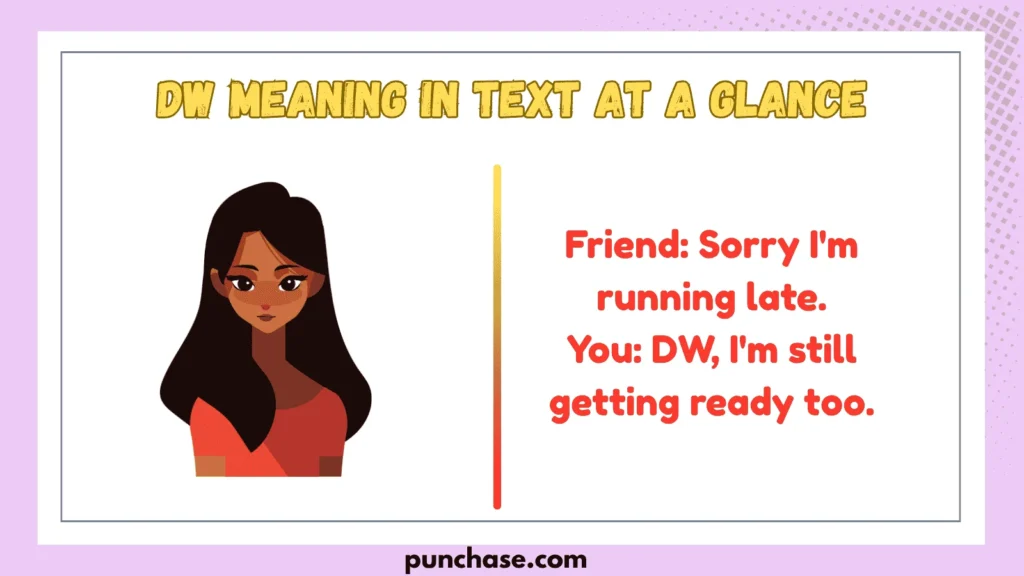
For readers looking for a quick answer, here’s the featured-snippet version:
DW means “Don’t Worry” in text messages, online chats, social media conversations, and gaming communities. It is used to reassure someone or tell them that a situation is not a problem.
Example:
Friend: Sorry I’m running late.
You: DW, I’m still getting ready too.
The Origin of DW in Online Communication
Like many internet abbreviations, DW emerged from the need for faster communication.
During the early days of:
- Online chat rooms
- Instant messaging
- Text messaging
- Mobile phones with limited keyboards
People started shortening common phrases into initials.
Some popular examples included:
| Abbreviation | Meaning |
| LOL | Laugh Out Loud |
| BRB | Be Right Back |
| IDK | I Don’t Know |
| IMO | In My Opinion |
| DW | Don’t Worry |
Since “don’t worry” is used frequently in conversations, it naturally became shortened to DW.
Over time, the abbreviation spread across:
- SMS messages
- Social media platforms
- Online forums
- Gaming chats
- Workplace messaging apps
Today, DW is recognized worldwide.
How DW Is Used in Text Messages
The primary purpose of DW is reassurance.
Whenever someone feels nervous, apologetic, embarrassed, or concerned, DW can help make them feel better.
Example 1
Person A: Sorry I forgot to send the file.
Person B: DW, I already found it.
Example 2
Person A: I think I made a mistake.
Person B: DW, we can fix it.
Example 3
Person A: I’m worried about tomorrow’s presentation.
Person B: DW, you’ll do great.
In each example, DW helps reduce anxiety and create a positive tone.
Different Situations Where People Use DW
Casual Conversations
Friends often use DW in everyday chats.
Example:
DW, I’ll handle it.
Family Messages
Family members use DW to comfort each other.
Example:
DW Mom, I arrived safely.
School Conversations
Students use DW when discussing assignments or projects.
Example:
DW, I’ll share my notes with you later.
Workplace Chats
Professionals sometimes use DW in informal team discussions.
Example:
DW, the meeting has been rescheduled.
Gaming Communities
Gamers use DW frequently when teammates make mistakes.
Example:
DW, we’ll win the next round.
DW Meaning on Social Media
The DW meaning in text remains the same across most social media platforms.
People use it on:
- TikTok
- Snapchat
- X
- Discord
Social Media Examples
DW, I wasn’t offended.
DW about the comments.
DW, everything worked out.
Because social media encourages quick communication, abbreviations like DW remain extremely popular.
Examples of DW in Real-Life Conversations
Seeing examples makes understanding easier.
Example Conversation 1
Alex: Sorry for replying late.
Emma: DW, I was busy too.
Example Conversation 2
Jake: I think I broke the project.
Ryan: DW, I have a backup copy.
Example Conversation 3
Sarah: I’m nervous about the interview.
Lisa: DW, you’re well prepared.
Example Conversation 4
Mark: Sorry I couldn’t help yesterday.
John: DW, everything worked out fine.
These examples show how naturally DW fits into daily communication.
Why People Use DW Instead of “Don’t Worry”
Several reasons explain its popularity.
Saves Time ⏰
Typing two letters is much faster than typing “don’t worry.”
Fits Mobile Communication 📱
Short messages are easier to send and read.
Feels Casual 😊
DW creates a friendly and relaxed tone.
Common Internet Language 🌍
Many people already understand texting abbreviations.
Encourages Quick Responses 💬
Short messages help conversations move faster.
Alternative Meanings of DW
Although Don’t Worry is the most common definition, DW can occasionally have different meanings depending on context.
Possible Alternative Meanings
| DW Meaning | Context |
| Don’t Worry | Texting and chat |
| Dear Wife | Family discussions |
| Doctor Who | Entertainment discussions |
| Digital World | Technology topics |
| Driving While | Specific phrases |
However, when used in casual texting, DW almost always means Don’t Worry.
Context usually makes the intended meaning obvious.
DW vs Similar Texting Abbreviations
Many abbreviations share a similar purpose.
DW vs NVM
| DW | NVM |
| Don’t Worry | Never Mind |
| Provides reassurance | Ends a topic |
Example:
DW, it’s okay.
NVM, I figured it out.
DW vs NP
| DW | NP |
| Don’t Worry | No Problem |
Both are used to reassure someone.
Example:
DW about it.
NP, happy to help.
DW vs It’s Fine
Both expressions reduce concern.
Example:
DW, everything’s fine.
It’s fine, don’t worry.
When You Should Use DW
DW works best when:
- Someone apologizes
- Someone feels stressed
- Someone is worried
- Someone made a small mistake
- You want to comfort another person
Good Examples
DW, mistakes happen.
DW, we still have time.
DW, I understand.
DW, you’re doing great.
These messages create a supportive atmosphere.
When You Should Avoid Using DW
Even though DW is useful, it isn’t appropriate for every situation.
Formal Business Emails
Instead of DW, write:
Don’t worry.
or
There is no issue.
Serious Situations
If someone is dealing with a major problem, a longer response may be more helpful.
Instead of:
DW
Try:
I understand your concern. Let’s work through it together.
Professional Documents
Formal writing should avoid texting abbreviations.
Common Mistakes People Make With DW
Using It in Very Formal Settings
Professional communication usually requires complete words.
Assuming Everyone Knows It
Some people may not understand internet slang.
Using It for Serious Concerns
A simple DW can sometimes feel dismissive.
Overusing It
Repeating DW constantly can make conversations sound repetitive.
Balance is important.
DW Meaning Across Different Age Groups
Interestingly, DW is understood by people of various ages.
Teenagers
Teenagers use DW frequently in texting and social media.
Example:
DW, I’ll send it later.
Young Adults
Young adults often use it in both personal and professional chats.
Example:
DW, the deadline was extended.
Adults
Adults increasingly understand common texting abbreviations.
Example:
DW, I’ll take care of it.
Because digital communication is now part of everyday life, DW has become widely recognized.
Emotional Impact of Using DW
One reason DW remains popular is its positive emotional effect.
When people are worried, stressed, or embarrassed, hearing reassurance can immediately improve their mood.
DW Can Communicate
- Kindness 🤝
- Support 🌟
- Understanding 💙
- Patience 🌱
- Encouragement 🚀
A simple two-letter abbreviation can make conversations feel warmer and more welcoming.
Popular DW Text Examples You Can Use
Here are some ready-to-use examples:
- DW, I’ve got it covered.
- DW, everything is under control.
- DW, it wasn’t your fault.
- DW, I’ll help you.
- DW, there’s still plenty of time.
- DW, I understand.
- DW, we can figure it out.
- DW, it happens to everyone.
- DW, you’re doing fine.
- DW, we’ll solve it together.
These examples sound natural in everyday conversations.
Is DW Still Popular in 2026?
Absolutely.
Despite the rise of emojis, voice notes, and video messaging, abbreviations remain a major part of online communication.
DW continues to be popular because:
- It’s short
- It’s easy to understand
- It’s friendly
- It conveys reassurance instantly
As digital conversations evolve, simple abbreviations like DW remain highly effective.
FAQs
What does DW mean in text?
DW stands for Don’t Worry. It is used to reassure someone or tell them that a situation is okay.
Is DW rude?
No. DW is generally considered polite and supportive when used appropriately.
Can DW have multiple meanings?
Yes. Depending on the context, DW can mean Dear Wife, Doctor Who, or Digital World. However, in texting it usually means Don’t Worry.
Is DW used on social media?
Yes. DW is commonly used on Instagram, Snapchat, TikTok, Facebook, Discord, and other social platforms.
Should I use DW in professional emails?
It is better to write “don’t worry” in full within formal business communication.
Final Thoughts
Understanding the DW meaning in text helps you communicate more confidently in modern digital conversations. In most situations, DW simply means “Don’t Worry.” It is a friendly abbreviation used to reassure others, reduce stress, and keep conversations positive.
Whether you’re texting friends, chatting online, using social media, or participating in gaming communities, you’ll likely encounter DW regularly. Knowing its meaning and proper usage allows you to respond naturally and avoid confusion.
The next time someone sends you “DW,” you’ll know they’re simply telling you to relax and that everything is okay. 😊