Understanding slang is essential in today’s digital world, especially when people use short forms like ion meaning in text in chats, social media, and messaging apps. If you’ve ever seen “ion” in a message and felt confused, you are not alone. This term is widely used in online conversations, especially among younger users and social media communities.
In this detailed guide, we will break down everything about ion meaning in text, including its slang definition, origin, usage examples, emotional tone, and how it fits into modern communication. By the end, you will clearly understand how and when to use it correctly in conversations.
What Does Ion Mean in Text? 🧠
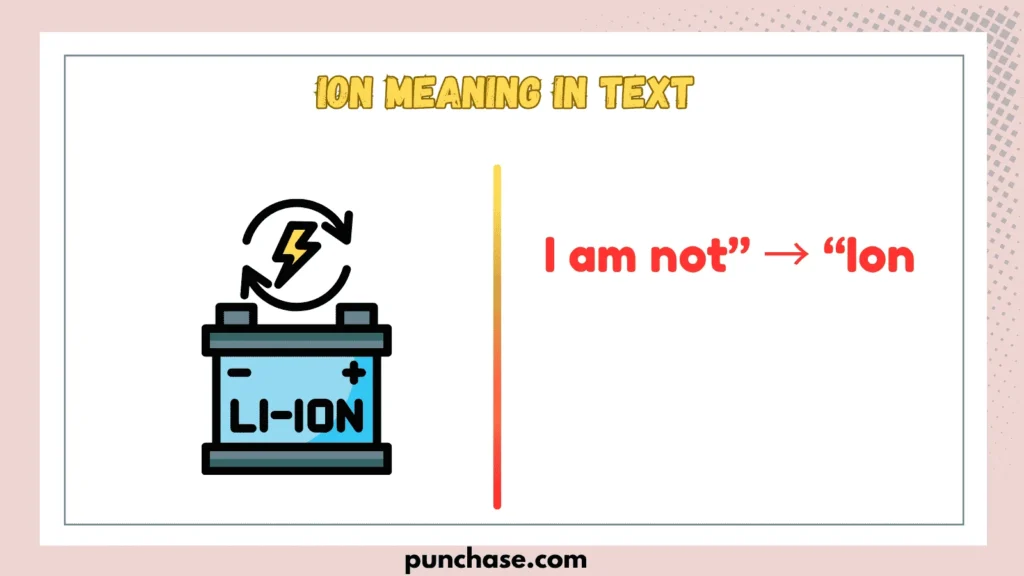
The phrase ion meaning in text generally refers to a slang abbreviation of the words “I don’t” or sometimes “I am not” depending on context.
In most casual conversations, “ion” is used as a relaxed, fast way of typing:
- “I don’t” → “Ion”
- “I am not” → “Ion”
This usage is very common in informal texting, especially in social media platforms like TikTok, Snapchat, and Instagram DMs.
Example:
- “Ion know what happened” = I don’t know what happened
- “Ion like that idea” = I don’t like that idea
So, when people search for ion meaning in text, they are usually trying to understand this shortcut used in casual speech.
Origin of Ion in Internet Slang 🌐
The origin of ion meaning in text is deeply rooted in internet speech patterns and African American Vernacular English (AAVE). Over time, digital communication platforms shortened everyday phrases for faster typing and more expressive tone.
Instead of typing full sentences like “I don’t know,” users started blending sounds together:
- I don’t know → Ion know
- I don’t care → Ion care
This evolution happened naturally as texting culture became faster and more expressive.
The rise of short-form content platforms also boosted the popularity of this slang because users wanted quick, punchy expressions.
Ion vs ION in Chemistry vs Slang ⚗️
One of the most confusing parts of ion meaning in text is that it looks identical to a scientific term.
Let’s clearly separate both meanings:
1. Ion in Science
In chemistry, an ion is a charged particle formed when an atom gains or loses electrons.
2. Ion in Text Slang
In texting, ion means:
- “I don’t”
- “I am not”
Quick Comparison Table:
| Context | Meaning | Example |
|---|---|---|
| Chemistry | Charged particle | Sodium ion (Na⁺) |
| Text Slang | I don’t / I am not | Ion know what happened |
So, when discussing ion meaning in text, we are NOT talking about science but informal language.
How Ion Is Used in Texting Conversations 💬
The slang ion meaning in text becomes clearer when you see it in real conversations.
Here are common ways it appears:
1. Expressing Negation
- “Ion want to go outside today”
- Meaning: I don’t want to go outside today
2. Showing Uncertainty
- “Ion think that’s right”
- Meaning: I don’t think that’s right
3. Casual Reactions
- “Ion even care anymore”
- Meaning: I don’t even care anymore
4. Emotional Tone
It often expresses:
- Laziness 😌
- Indifference 😶
- Honesty 💭
- Informal attitude 🗣️
This makes ion meaning in text a flexible slang used in emotional expression.
Why People Use Ion Instead of Full Sentences 🚀
The popularity of ion meaning in text comes from communication efficiency and style.
Here are key reasons:
1. Faster Typing
People prefer short forms in fast conversations.
2. Informal Tone
It creates a relaxed and natural feeling.
3. Social Media Influence
Platforms like TikTok and Instagram promote slang usage.
4. Identity Expression
Users feel more connected to modern digital culture.
5. Trend-Based Language
Slang evolves quickly online, and “ion” became part of that trend.
So, ion meaning in text is not just grammar; it is cultural communication.
Different Variations of Ion in Chat Language 🧾
The slang does not always appear in one form. Here are variations of ion meaning in text:
Common Variants:
- Ion = I don’t / I am not
- Ion’t = I don’t
- Ion even = I don’t even
- Ion care = I don’t care
Example Sentences:
- “Ion’t know what you mean”
- “Ion even understand this situation”
- “Ion care about drama”
Each version keeps the same informal tone but adjusts emotional intensity.
Psychological Impact of Using Ion in Texting 🧠
Language affects how we express emotions. The use of ion meaning in text reflects:
1. Informality and Comfort
People feel more relaxed using slang.
2. Emotional Distance
It can reduce emotional intensity in messages.
3. Identity Expression
Users feel part of online culture.
4. Speed of Thought
It helps match fast thinking with fast typing.
For example:
- Formal: “I do not understand this situation.”
- Slang: “Ion understand this”
The second feels more natural in digital chat.
Ion Meaning in Social Media Culture 📱
Social media has played a huge role in spreading ion meaning in text.
Platforms Where It Is Common:
- TikTok
- Snapchat
- Twitter (X)
How It Is Used:
- In comments
- In captions
- In video subtitles
- In memes
Example:
- “Ion even stress anymore, I’m just vibing”
This shows how ion meaning in text has become part of internet identity and humor.
Examples of Ion in Real Conversations 💡
Let’s explore real-life chat examples to fully understand ion meaning in text:
Example 1:
A: “Are you coming to the party?”
B: “Ion think so”
Example 2:
A: “Did you finish homework?”
B: “Ion do it yet”
Example 3:
A: “Do you like this idea?”
B: “Ion really like it”
These examples show how natural the slang feels in everyday texting.
Common Misunderstandings About Ion ❗
Many people misunderstand ion meaning in text because it looks like a scientific word.
Misconception 1:
“It means electricity or chemistry”
- Reality: In texting, it does not
Misconception 2:
“It is a typo”
- Reality: It is intentional slang
Misconception 3:
“It has only one meaning”
- Reality: It can mean “I don’t” or “I am not”
Understanding these differences helps avoid confusion in conversations.
When You Should and Shouldn’t Use Ion ⚖️
Knowing ion meaning in text is not enough; you must also know when to use it.
Good Situations:
- Chatting with friends
- Social media comments
- Casual conversations
- Meme content
Avoid Using In:
- Professional emails
- Academic writing
- Formal communication
- Job applications
Using slang in formal settings can reduce clarity and professionalism.
Evolution of Ion in Digital Language 📊
The growth of ion meaning in text reflects how language evolves online.
Stage 1: Full sentences
People wrote complete grammar-based messages.
Stage 2: Short forms
Abbreviations like “idk” and “brb” became popular.
Stage 3: Slang evolution
Words like “ion” replaced full phrases.
Stage 4: Cultural slang
It became part of identity and expression.
This evolution shows how digital communication continues to change rapidly.
Expert Insights on Ion Usage 🧑🏫
Linguistic experts suggest that slang like ion meaning in text is part of natural language evolution.
Key observations include:
- Language adapts to speed of communication
- Youth culture drives slang innovation
- Online platforms accelerate word transformation
- Informal speech becomes digital standard
This means ion meaning in text is not random; it is part of linguistic growth.
FAQs
1. What does ion mean in text?
It usually means “I don’t” or “I am not” in casual texting.
2. Is ion a real word?
Yes, but in texting it is slang, not formal grammar.
3. Why do people use ion instead of I don’t?
Because it is faster, easier, and more casual.
4. Is ion used in professional writing?
No, it is only for informal communication.
5. Does ion have the same meaning everywhere?
Mostly yes, but context decides if it means “I don’t” or “I am not.”
Conclusion
The phrase ion meaning in text is a modern example of how digital communication transforms language. It simplifies expressions like “I don’t” into a quick, casual form used widely across social media and messaging apps.
Understanding this slang helps you communicate better in online conversations and stay updated with evolving internet language trends. While it is not suitable for formal use, it is highly effective in casual chats.